15445-01-Relational Model & Algebra
发布于 • 作者: Ethan
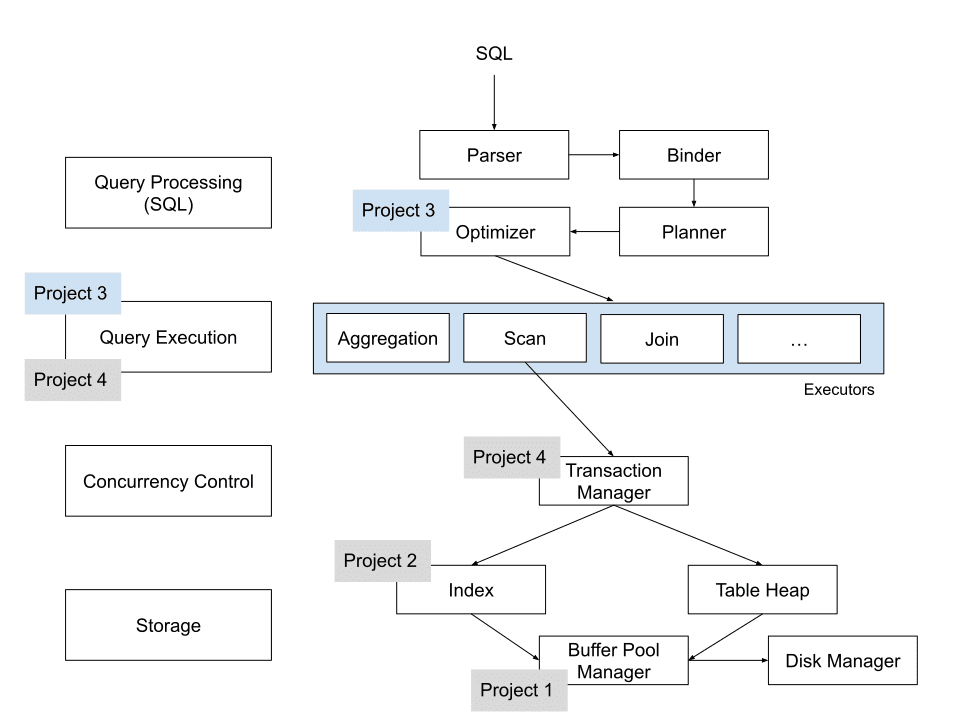
A database is an organized collection of inter-related data that models some aspect of the real world (e.g., modeling the students in a class or a digital music store). Databases are the core component of most computer applications. Computer Science is essentially taking in some input, performing some operations, and then producing the output — which can also be seen as a form of database. 数据库是一个有组织的、相互关联的数据集合,用于模拟现实世界的某个方面(例如,模拟一个班级的学生或数字音乐商店)。数据库是大多数计算机应用的核心组件。计算机科学本质上是在接收一些输入、执行一些操作,然后产生输出——这也可以被视为一种数据库。
People often confuse “databases” with “database management systems (DBMS)” (e.g., MySQL, Oracle, MongoDB, Snowflake). 人们常常混淆“数据库”与“数据库管理系统(DBMS)”(例如,MySQL、Oracle、MongoDB、Snowflake)。 A DBMS is software that manages a database. Among many things, a DBMS is responsible for inserting, deleting, and retrieving data from a database. DBMS 是管理数据库的软件。在许多方面,DBMS 负责向数据库插入、删除和检索数据。
Consider that we want to store data for a music store like Spotify.
考虑我们想要存储类似 Spotify 的音乐商店的数据。
We want to hold information about artists and the albums those artists have released.
我们想要存储有关艺术家以及这些艺术家发行过的专辑的信息。
This database has two entities: an Artists entity and an Albums entity.
这个数据库有两个实体:一个 Artists 实体和一个 Albums 实体。
We choose to store the database’s records as comma-separated value (CSV) files that the DBMS manages, and each entity is stored in its own file (artists.csv and albums.csv).
我们选择将数据库的记录存储为 DBMS 管理的逗号分隔值(CSV)文件,并且每个实体都存储在其自己的文件( artists.csv 和 albums.csv )中。
Example schema: 示例架构:
Example CSV for artists: 艺术家示例 CSV:
"Wu-Tang Clan", 1992, "USA"
"Notorious BIG", 1992, "USA"
"GZA", 1990, "USA"
Example Python-like pseudocode: 示例 Python 风格伪代码:
for line in file.readlines():
    record = parse(line)
    if record[0] == "GZA":
        print(int(record[1]))
Data Integrity: 数据完整性:
Implementation: 实现:
Durability: 持久性:
A DBMS allows applications to store and analyze information in a database. 数据库管理系统 (DBMS) 允许应用程序在数据库中存储和分析信息。 A general-purpose DBMS supports definition, creation, querying, update, and administration of databases in accordance with some data model. 一种通用型数据库管理系统支持根据某种数据模型进行数据库的定义、创建、查询、更新和管理。
A schema is a description of a particular collection of data using a given data model — defining its structure and meaning. 模式是使用给定数据模型对特定数据集合的描述——定义其结构和含义。
| Type类型 | Examples / Usage示例 / 使用 |
|---|---|
| Relational关系 | Most DBMSs大多数数据库管理系统 |
| Key/Value键/值 | Simple Apps / Caching简单应用 / 缓存 |
| Graph图 | NoSQL |
| Document / XML / Object文档 / XML / 对象 | NoSQL |
| Wide-Column / Column-family宽列 / 列族 | NoSQL |
| Array / Matrix / Vector数组 / 矩阵 / 向量 | ML / ScientificML / 科学 |
| Hierarchical层次结构 | Obsolete / Legacy过时/遗留 |
| Network网络 | Obsolete / Legacy过时 / 遗留 |
| Multi-Value多值 | Obsolete / Legacy过时 / 遗留 |
In the 1960s, DBMSs (e.g., IDS, IMS, CODASYL) required procedural queries. 20 世纪 60 年代,数据库管理系统(如 IDS、IMS、CODASYL)需要过程性查询。 Developers had to write code specifying access paths and ordering — meaning changes to the data required rewriting code. 开发者必须编写代码来指定访问路径和排序——这意味着数据的变化需要重写代码。 Queries involved explicit loops and navigation orders; thus, assumptions could easily break as data grew. 查询涉及显式循环和导航顺序;因此,随着数据的增长,假设很容易被打破。
Proposed by Ted Codd at IBM in the late 1960s. 由 IBM 的 Ted Codd 于 20 世纪 60 年代末提出。
The relational data model defines three main concepts: 关系数据模型定义了三个主要概念:
NOT NULL, UNIQUE, FOREIGN KEY).
约束:用户定义的条件,必须成立(例如, NOT NULL , UNIQUE , FOREIGN KEY )。DMLs are APIs that allow applications to store and retrieve data from a DBMS. DMLs 是允许应用程序存储和从 DBMS 检索数据的 API。
Two main classes: 两大主要类别:
Procedural: 过程式: The query specifies how to retrieve the data. 查询指定了如何检索数据。 Example: Iterate through all records in a loop. 示例:在循环中遍历所有记录。
Non-Procedural (Declarative): 非过程式(声明式): The query specifies what data to retrieve, not how. 查询指定了要检索什么数据,而不是如何检索。 Example: 示例:
SELECT COUNT(*) FROM artist;
A formal system of operations for retrieving and manipulating tuples in relations. 一种用于检索和操作关系中的元组的正式运算系统。 Each operator takes one or more relations as input and outputs a new relation. 每个运算符以一个或多个关系作为输入,并输出一个新的关系。 Operators can be chained to build complex queries. 操作符可以串联起来构建复杂的查询。
Filters tuples satisfying a predicate. 过滤满足谓词的元组。
Syntax: 语法: σpredicate(R)
Example: 示例: σa_id=’a2’(R)
SQL Equivalent: SQL 等价:
SELECT * FROM R WHERE a_id = 'a2';
Selects specific attributes from a relation. 从关系中选取特定属性。
Syntax: 语法: πA1,A2,...,An(R)
Example: 示例: πb_id-100, a_id(σa_id=’a2’(R))
SQL Equivalent: SQL 等价:
SELECT b_id-100, a_id FROM R WHERE a_id = 'a2';
Combines tuples from both relations (must have same schema). 合并两个关系中的元组(必须具有相同的模式)。
Syntax: 语法: R ∪ S
SQL Equivalent: SQL 等价:
(SELECT * FROM R)
UNION ALL
(SELECT * FROM S);
Returns tuples present in both relations. 返回同时存在于两个关系中的元组。
Syntax: 语法: R ∩ S
SQL Equivalent: SQL 等价:
(SELECT * FROM R)
INTERSECT
(SELECT * FROM S);
Returns tuples in the first relation but not in the second. 返回第一个关系中存在但第二个关系中不存在的元组。
Syntax: 语法: R − S
SQL Equivalent: SQL 等价:
(SELECT * FROM R)
EXCEPT
(SELECT * FROM S);
Cartesian product of two relations. 两个关系的笛卡尔积。
Syntax: 语法: R × S
SQL Equivalent: SQL 等价:
SELECT * FROM R CROSS JOIN S;
-- or simply
SELECT * FROM R, S;
Combines tuples from two relations based on shared attributes. 根据共享属性组合两个关系中的元组。
Syntax: 语法: R ▷◁ S
SQL Equivalent: SQL 等价:
SELECT * FROM R JOIN S USING (ATTRIBUTE1, ATTRIBUTE2...);
Relational Algebra defines both operations and order of execution. 关系代数定义了操作和执行顺序。
Example comparison: 示例比较:
Although results are the same, the second is much more efficient if S is large. 尽管结果相同,但如果 S 很大,第二种方法效率高得多。
In SQL, the user specifies what to compute, not how to compute it — the DBMS performs query optimization. 在 SQL 中,用户指定要计算什么,而不是如何计算——数据库管理系统执行查询优化。
pgvector) for efficient NN search.
许多关系型数据库管理系统现在支持向量索引(例如 pgvector ),以实现高效的最近邻搜索。