计算机网络(二)
发布于 • 作者: Ethan
The number of bits transferred over the network per time.
e.g. 10Mbps network = send 10 Million bits per second
Time to travel one end to the other.
Round Trip Time (RTT) = time to reach the other end and back.
Latency = Propagation + Transmit + Queue
Propagation = Distance / SpeedOfLight
Transmit = Size / Bandwidth
Another way to think about latency is in terms of instructions per mile.
Bandwidth-Delay Product: the number of bits that could be in transit through the link at any given instant.
BDP = Bandwidth * RTT
Higher Bandwidth != Lower Latency
To improve communication either
In other words, we need to maximize throughput:
Throughput = TransferSize / TransferTime
The variation in latency from packet to packet.
It impacts streaming applications (e.g. video/audio).
Causing discontinuity due to variable packet arrival. If know the lower & upper bounds on latency can avoid by delaying the time to start the vedio.
The standard interface for app's processes to itneract w/ the network and communicate w/ each other.
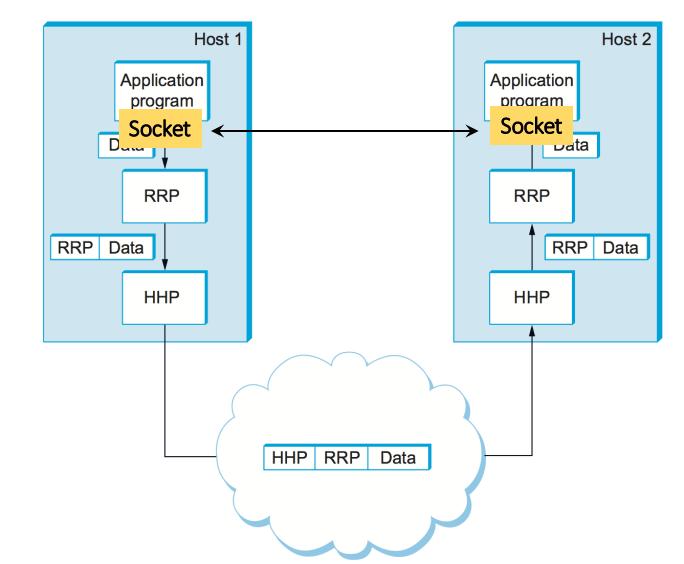
5-tuple uniquely id a socket connection between hosts:
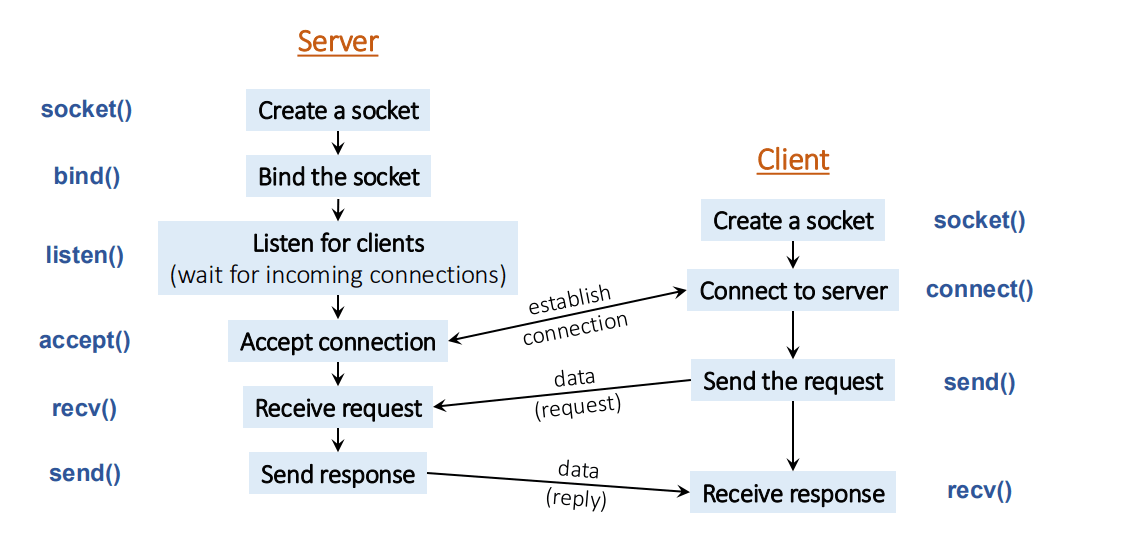

Server:
getaddrinfo(NULL, MY_PORT, &hints, &result);
//hints.ai_family = AF_UNSPEC; (IPv4 or IPv6, whichever)
//hints.ai_socktype = SOCK_STREAM (TCP) or SOCK_DGRAM (UDP)
sockfd = socket(result->ai_family, result->ai_socktype, result->ai_protocol);

bind(sockfd, res->ai_addr, res->ai_addrlen);

listen(sockfd, QUEUE_LENGTH);

new_fd = accept(sockfd, (struct sockaddr *)&their_addr, &addr_size);
Client:
getaddrinfo(NULL, MY_PORT, &hints, &result);
//hints.ai_family = AF_INET; (IPv4)
//hints.ai_socktype = SOCK_STREAM (TCP) or SOCK_DGRAM (UDP)
//hints.ai_flags = AI_PASSIVE; (suitable for binding)
sockfd = socket(result->ai_family, result->ai_socktype, result->ai_protocol);

connect(sockfd, res->ai_addr, res->ai_addrlen);

bytes_sent = send(sockfd, msg, len, 0);

recv(int sockfd, void *buf, int len, int flags);
Network byte order is Big Endian (most significant bit/byte stored first).
Functions to deal with:
htons(), htonl(): host to network short and long.
ntohs(), ntohl(): network to hsot short and long.
use when put/pull data on/off wire.
Serializing requests is inefficient, use: